
by Amy Pajula, on October 17, 2026
If you've been researching hearing implants, you have likely come across both active middle ear implants and cochlear implants. While both are designed to help people hear better, they work in different ways and are intended for different levels of hearing loss. 1, 2
For some individuals, implantable hearing technology may offer a treatment option when non- surgical hearing devices such as hearing aids have not provided the desired benefit. Understanding the differences between active middle ear implants and cochlear implants can help you have a more informed conversation with your hearing healthcare team about which options may be appropriate for you. 1,2
What is an Active Middle Ear Implant?
An active middle ear implant is a surgically implanted hearing device that directly interacts with structures of the middle ear, including the ossicles. Unlike a passive prosthetic device like a hearing aid, an active middle ear implant uses implanted transducers in the middle ear to capture sound and deliver amplified vibrational energy to the inner ear.2
According to the American Academy of Otolaryngology-Head and Neck Surgery, active middle ear implants are established treatment options for appropriately selected patients with hearing loss. They were developed to provide an alternative form of hearing treatment for people who may not achieve their desired results with traditional hearing devices.3
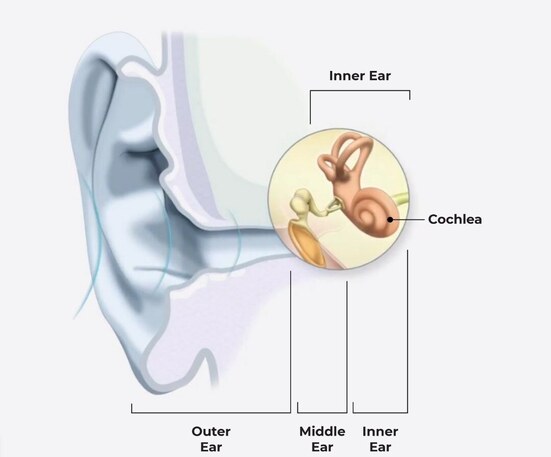
The middle ear (see diagram below) includes the eardrum and three small bones (malleus, incus, and stapes, also known as the hammer, anvil, and stirrup). These structures work together to transmit sound. Active middle ear implants (AMEIs) can be either fully implanted, with no externally worn components, or semi-implanted with both an internal and external component. 2
The only FDA-approved fully implanted active middle ear implant is the Esteem® fully implanted active middle ear implant (FI-AMEI), which is approved by the U.S. Food and Drug Administration (FDA) for adults with moderate-to-severe sensorineural hearing loss who meet specific candidacy requirements.4
The Esteem® system leverages the natural movement of the eardrum and middle ear structures to detect sound vibrations. Those vibrations are captured, processed and delivered back to the middle ear through implanted components, allowing amplified sound information to continue traveling through the ear's natural hearing pathway.4
In simple terms, an active middle ear implant is designed to help people make better use of the hearing they still have.2
As with any surgical procedure, implantation of an active middle ear implant involves potential risks and benefits that should be discussed with a physician. The FDA-approved labeling for the Esteem® Hearing Implant contains additional information regarding candidacy, contraindications, warnings, and precautions.4
What Is a Cochlear Implant?
A cochlear implant is designed for people with more advanced hearing loss who may still struggle to understand speech even when using conventional hearing aids.5 Instead of simply making sound louder, a cochlear implant converts sound into electrical signals that bypass damaged parts of the inner ear and directly stimulate the auditory nerve, which then carries those signals to the brain.1
The National Institute on Deafness and Other Communication Disorders (NIDCD) notes that cochlear implants do not restore normal hearing. Instead, they provide access to sound that recipients learn to interpret through listening experience and rehabilitation.1 As with any surgical procedure, cochlear implant surgery also involves potential risks and benefits that should be discussed with a qualified healthcare professional. Cochlear implants do not restore normal hearing, and outcomes can vary from person to person. 1,5
Bottom Line
Not every hearing solution is appropriate for every person.
That is why treatment decisions are based on far more than results of a hearing test or an audiogram. Speech understanding, medical history, lifestyle considerations, and individual hearing goals are important factors when determining the most ideal hearing loss treatment for an individual. Comprehensive candidacy evaluations matter because the right option depends on the full clinical picture, not just a hearing test result.1,5
If you're exploring hearing implants, a strong next step is to talk with a qualified hearing implant team that can evaluate your hearing and help determine which options may be appropriate for you.
*This content is intended for informational purposes only. It is not medical advice. Please consult a licensed healthcare professional before making decisions about your hearing health.
Sources
1. National Institute on Deafness and Other Communication Disorders (NIDCD). [Cochlear Implants](https://www.nidcd.nih.gov/health/cochlear-implants).
2. Emmett, S. D., Bareiss, A., & Tucci, D. L. (2026). Active Middle Ear Implants. In A. D. Sweeney, G. B. Wanna, M. L. Carlson, & E. L. Perkins (Eds.), *Haynes-Glasscock-Shambaugh Surgery of the Ear*. Springer, Cham. [https://doi.org/10.1007/978-3-032-18264-7_17](https://doi.org/10.1007/978-3-032-18264-7_17).
3. American Academy of Otolaryngology–Head and Neck Surgery. [Position Statement: Active Middle Ear Implants](https://www.entnet.org/resource/position-statement-active-middle-ear-implants/).
4. U.S. Food and Drug Administration (FDA). [Esteem Hearing Implant: Premarket Approval (P090018)](https://www.accessdata.fda.gov/scripts/cdrh/cfdocs/cfpma/pma.cfm?id=P090018).
5. Mayo Clinic. [Cochlear Implants](https://www.mayoclinic.org/tests-procedures/cochlear-implants/about/pac-20385021)